
Why migration assessments reduce delivery risk
SQL Server to Snowflake migrations are frequently underestimated. Procedural logic, database dependency patterns relevant to ETL modernization, unsupported SQL patterns, and cross-system references are typically not visible in a table count or schema summary — and surface late in the program when correction is expensive.
A structured migration complexity assessment surfaces these drivers early, while planning and budgets are still adjustable.
- Identify complexity early — detect procedural and dependency risks relevant to migration and ETL modernization before project kickoff
- Improve estimation and planning — use analyzed complexity signals, inventory, and dependencies instead of assumptions
- Prioritize remediation focus — focus on objects with the highest rewrite and validation impact
What SQL2Snow analyzes
SQL2Snow scans SQL Server environments to produce a structured picture of migration complexity. Analysis is deterministic and rule-based — results are explainable and repeatable.
Database inventory analysis
Tables, views, stored procedures, functions, triggers, and indexes — scanned across one or more databases to produce a structured object inventory.
Stored procedure analysis
Identifies patterns that drive rewrite effort and testing scope. Detected signals include: CURSOR #temp tables dynamic SQL TRY/CATCH RAISERROR
Unsupported SQL pattern detection
Flags SQL Server constructs with no direct Snowflake equivalent that require manual redesign: CLR XML patterns OPENQUERY linked servers cross-db references
Migration complexity indicators
Each object is scored for complexity (Low / Medium / High) using deterministic rule hits, producing a ranked list of highest-complexity migration targets.
Dependency patterns relevant to ETL modernization
Surfaces cross-database references, linked servers, and external dependency patterns that can increase coordination and redesign effort during migration.
Assessment outputs
SQL2Snow generates structured, human-readable outputs designed for both technical review and executive planning discussions.
Technical outputs
- Object inventory: tables, views, procedures, functions
- Complexity scores per object (Low / Medium / High)
- Rule-hit detail: cursors, temp tables, dynamic SQL, cross-db references
- Top highest-complexity objects for remediation focus
- Draft Snowflake DDL for table schemas
- Structured assessment JSON export
Planning and executive outputs
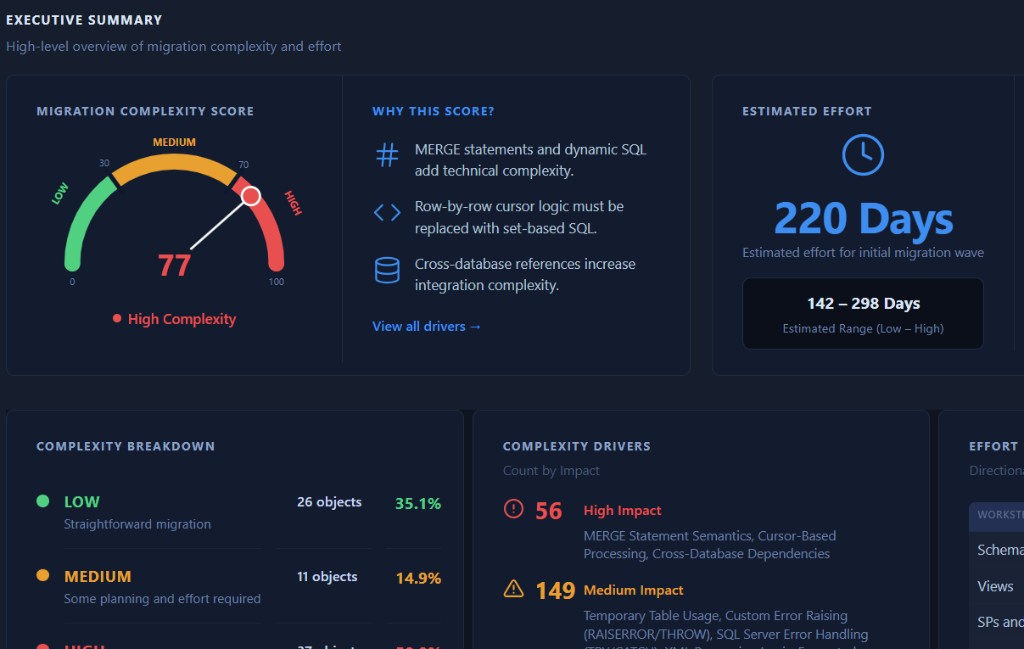
- Migration Complexity Score (0–100)
- Estimated effort and Low–High range
- Complexity breakdown by object and level
- Top complexity drivers and highest-complexity objects
- Prioritized recommendations
- Executive-ready migration assessment summary
Common SQL Server to Snowflake migration complexity drivers
Migration complexity is commonly driven by stored procedure rewrites, dependency density, testing, data model refactoring, ETL and pipeline gaps, and organizational coordination.
Assessment workflow
SQL2Snow runs locally against your SQL Server environment. No data export required.
Assess your SQL Server environment
Run SQL2Snow locally to generate your migration assessment.